Concept image of an enclosed cargo trailer with roof and side-wing solar panels deployed on a desert lakebed

An open-source Regional prototype

The trailer that carries the camp can also help power it.

An open-source 7×16 cargo trailer that transports camp gear and an electric accessibility vehicle, then becomes a solar power system at the event.

Concept visualization · specifications are design targets, pending testing

~3.6 kW
solar
~10 kWh
storage
120 V
camp power
$6,000
personally committed

Why I’m building it.

I have multiple sclerosis and need an electric mobility vehicle for longer distances at large events. Bringing that vehicle creates two additional problems: transporting it and keeping it charged without also hauling a large generator and fuel.

At the same time, camps already bring trailers full of shade, tools, bikes, kitchen equipment and other infrastructure.

This project asks a simple question:

Can the trailer we already need also become part of the camp’s renewable-energy system?

Carries the camp

The enclosed trailer still transports shade, tools, bikes, kitchen equipment, an accessibility vehicle, and other camp infrastructure. Keeping useful cargo space is a core design requirement.
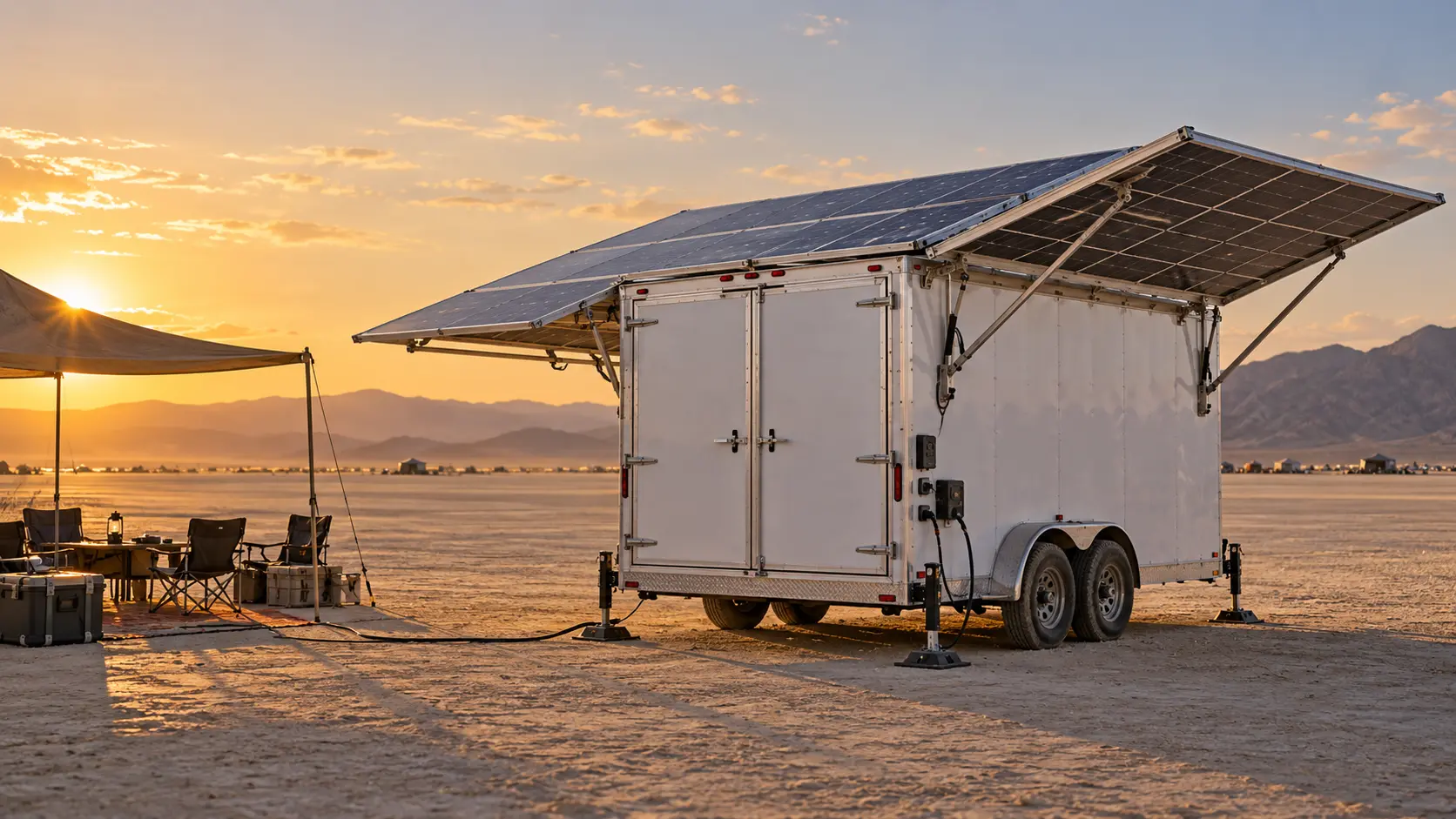
Powers the camp

At the event, fixed roof solar and deployable side wings charge the battery system and supply suitable 120 V loads. The aim is less fuel to transport and store, and less generator runtime.

One trailer. Three operating modes.
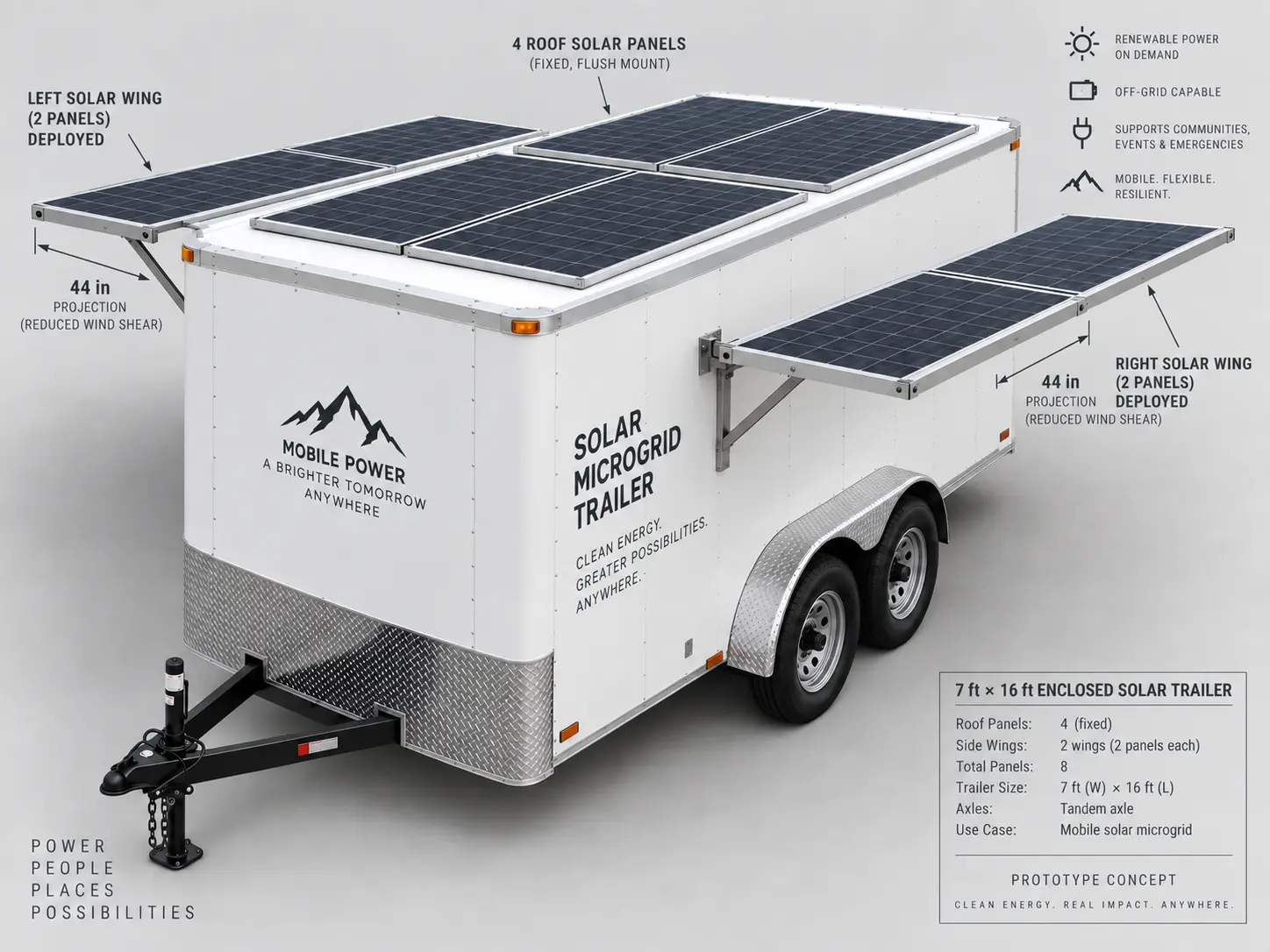
A cargo trailer with solar built in.

Concept rendering of a 7 by 16 foot enclosed trailer with four roof panels and two-panel folding solar wings on each side
Trailer concept reference

A 7×16 enclosed tandem-axle trailer with four fixed roof panels and two panels on each side. The folding wings extend about 44 inches and use triangular support braces. Structure, clearances, and wind behavior still need review and testing.

Current prototype targets

Trailer
7 ft × 16 ftEnclosed, tandem axle
Solar array
~3.6 kW8 panels total
Battery storage
~10 kWhLiFePO4
Camp output
120 VSuitable loads and vehicle charging
Roof
4 fixed panelsSeparate roof MPPT
Side wings
2 panels per sideIndependent wing branches
Wing extension
~44 inchesFrom each side when deployed
Wing supports
Triangular bracesFolding panels; retained cargo space

One MPPT for the roof. One for the wings.

Each side has two panels wired in series. The two side strings combine in parallel into a single wing MPPT charge controller. The roof array uses a separate MPPT.

Independent wing branches: either side can operate while the other remains stowed or disconnected. The roof array remains usable with both wings folded.

MODE 01 · BOTH SIDES DEPLOYED

Both wings open

Roof panels and both side wings collect solar when space and weather permit. Triangular support braces hold the folding wings in their deployed position.

  • Four roof panels and four side panels
  • Independent wing branches: either side can operate while the other remains stowed or disconnected
  • Both side strings share the wing MPPT
01Solar arraysroof + independent wing branches
02Charge controlroof MPPT + shared wing MPPT
03Battery bank~10 kWh LiFePO4 target
04120 V outputsuitable camp loads and charging

Conditions we need to test

The prototype has to work outside the brochure.

A

Dust and wind

Test dust intrusion, cleaning needs, and the effort needed to stow the wings. The high-wind plan is to fold both side wings down and continue from roof solar. Operating limits still need to be established.

B

Cloudy stretches

Measure how poor solar conditions affect generation, battery use, and the loads we can serve. Record backup charging when it is needed, along with its energy source.

C

Partial deployment

Test roof-only operation and each complete side separately. Measure the energy available with one side stowed, and check whether camp access and cargo loading remain practical.

D

Desert heat

Log equipment-bay temperatures, charging behavior, and any reduced output or shutdowns. Test whether the ventilation works in practice and document changes it needs.

A proposal, with results still to come

Proposed field test: BEquinox 2027

BEquinox 2027 is the proposed first Regional demonstration, subject to organizer approval and confirmation of event dates. Participation and a host partnership are not confirmed.

What we’ll test

  • Roof-only operation, one-side deployment, and both sides deployed
  • Solar production, including poor solar conditions
  • Accessibility vehicle charging and selected camp loads
  • Dust, heat, and the wing-stowing procedure
  • Setup effort and cargo capacity
  • Participant feedback and accessibility in everyday use

What we’ll record

  • Solar kWh generated and energy delivered to loads
  • Battery use and accessibility charging energy
  • Backup charging, its source, and the loads served
  • Setup and teardown time, including help required
  • Cargo space retained with the power system installed
  • Practical failures, limitations, and changes needed

The aim is to test where solar can realistically replace fuel-powered generation. We’ll record generator runtime and fuel use where they can be measured. Any estimated fuel or emissions savings will state the baseline and assumptions, including backup charging.

A build other camps can adapt

Build one. Document everything. Make the next one easier.

I’ll document the build and release the plans, actual costs, and test results as an open-source package. Other camps should be able to see what was built, what it took to operate, and what they would need to change.

Publishing what does not work is as important as publishing what does.

  • 01
    Itemized bill of materialsActual component prices, sources, substitutions, and weights
    PLANNED
  • 02
    Wiring diagramsRoof and wing circuits, charge controllers, storage, protection, and 120 V distribution
    PLANNED
  • 03
    Mechanical drawingsTrailer layout, folding-wing drawings, triangular support braces, latches, and cargo clearances
    PLANNED
  • 04
    Operating and maintenance guideSetup and teardown procedure, stowing, inspections, cleaning, and maintenance information
    PLANNED
  • 05
    Field data and accessibility observationsEnergy, loads, weather, cargo use, setup effort, charging, and participant feedback
    PLANNED
  • 06
    Build log and revisionsFailures, modifications, limitations, and lessons learned
    PLANNED

From planning to measured results

The next steps are practical ones.

  1. 01

    DESIGN + FUNDING

    Confirm the scope and costs

    I’m contributing $6,000 of personal savings, separate from labor and tools. The working prototype budget is still being refined. Grants, donations, and sponsorships are not secured.
  2. 02

    REVIEW + BUILD

    Keep the cargo space useful

    Review wiring, wing supports, payload, restraints, and vehicle access before construction. Install and commission the power system, then record the layout, parts, costs, and changes.
  3. 03

    SHAKEDOWN

    Measure what actually happens

    Check roof-only and partial deployment, accessibility charging, selected loads, setup effort, heat, and poor solar conditions. Record backup charging and failures as well as successful operation.
  4. 04

    PROPOSED DEMO

    BEquinox 2027

    Seek organizer approval and confirm dates before planning attendance. If approved, run the field-test plan and collect feedback on camp utility and accessibility.
  5. 05

    RELEASE

    Share the build and its limits

    Publish the open-source plans, real prices, operating instructions, test data, failures, and revisions so another camp can copy or adapt the design.

What the prototype needs to prove

Success looks like

Success is not just making electricity. It means the trailer:

  • Still works as useful cargo space
  • Safely charges the accessibility vehicle
  • Meaningfully reduces generator use for suitable loads
  • Works with roof-only and partial deployment
  • Handles real dust, heat, and wind within documented operating limits
  • Produces documentation detailed enough for another camp to copy or adapt
Explore the open-source plan